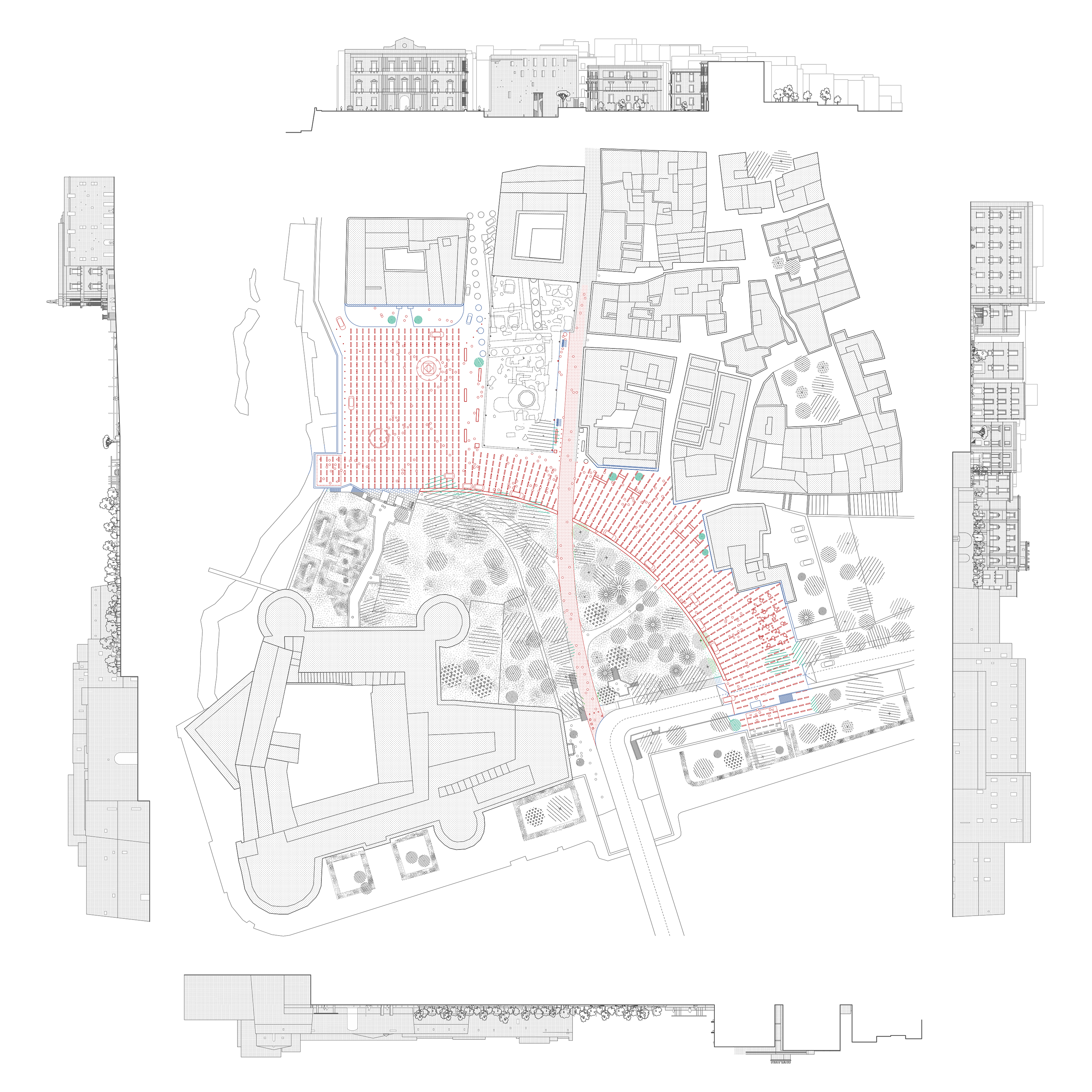
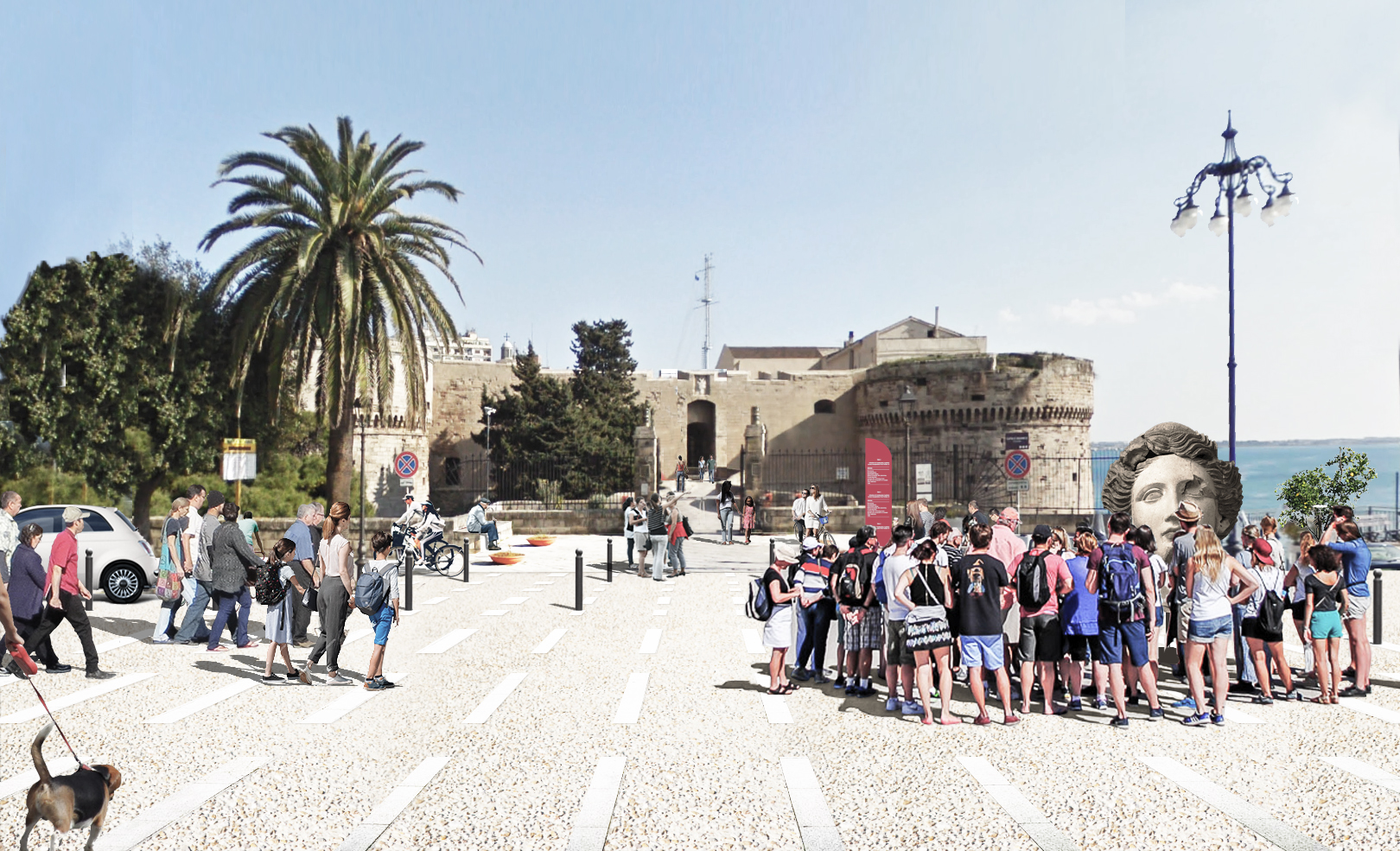
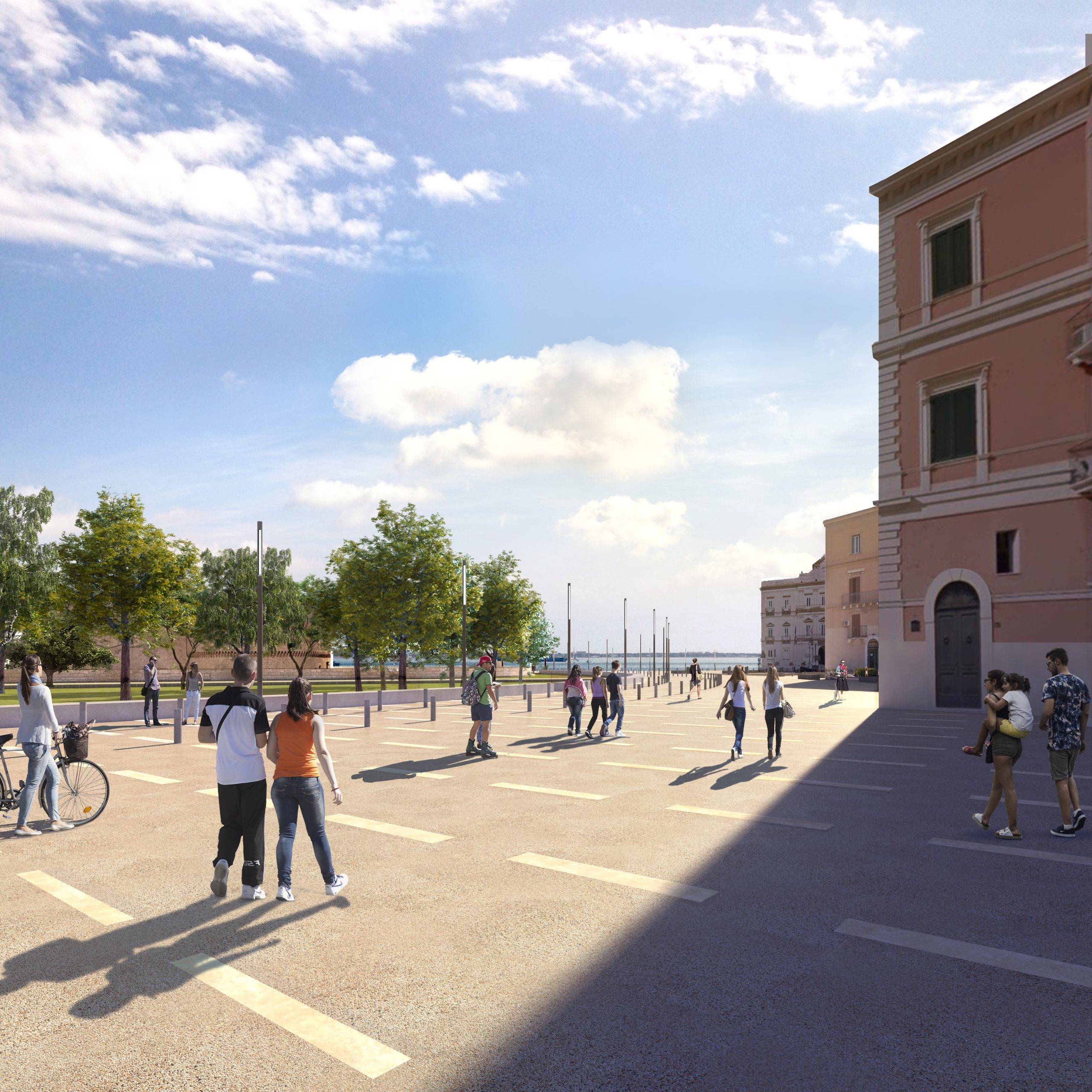
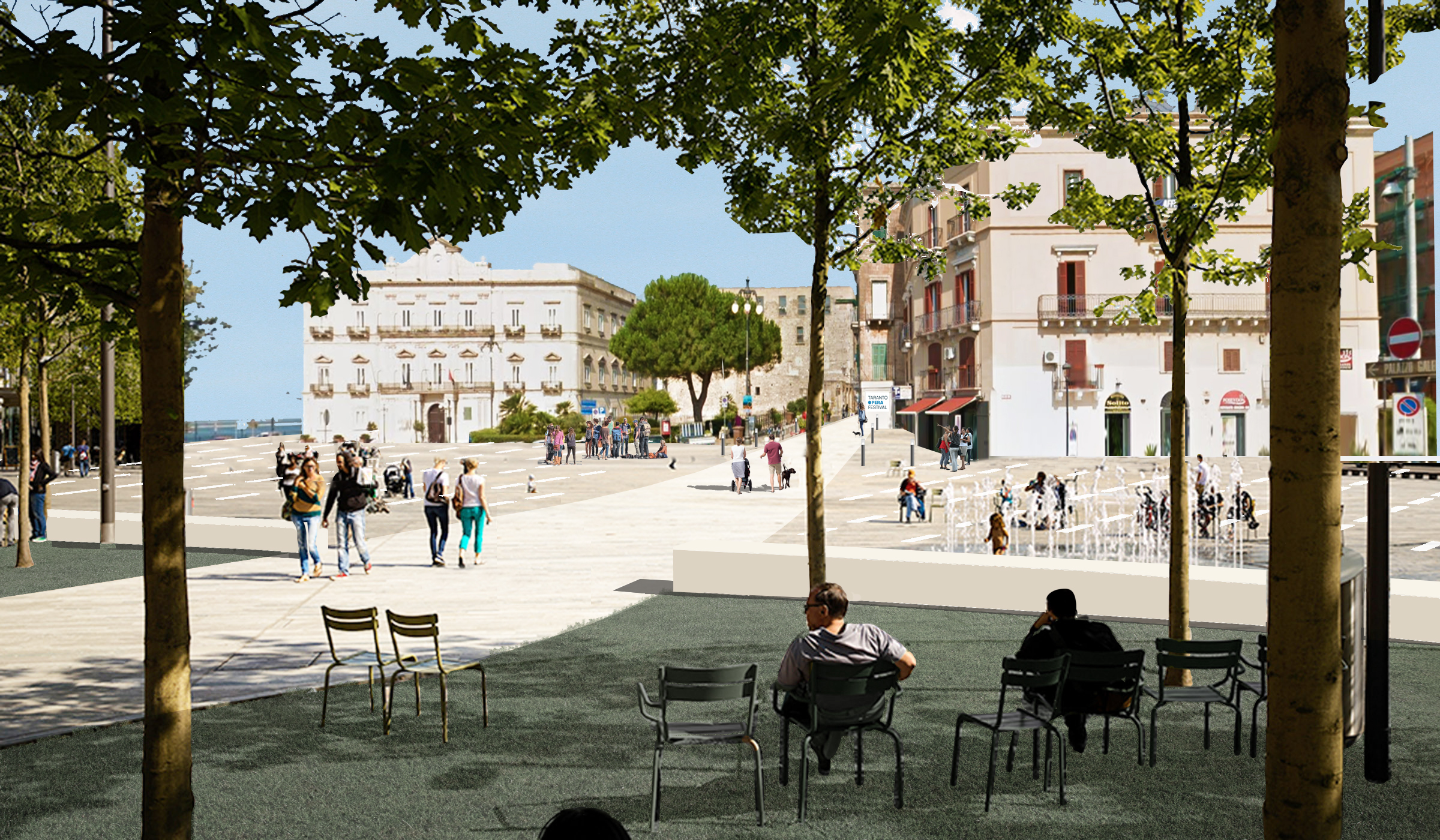
The design competition aims to identify proposals for the redevelopment of the public spaces between the Aragonese Castle and the City Hall of Taranto. The project will be closely integrated with the urban context, including the replacement of the square’s current asphalt surface with a solution in local stone that blends in with the rest of the historic paving. The primary objective is to restore the visual and formal relationship between the main architectural features—the Aragonese Castle and its park, the City Hall, the sea walls, and the remains of the Doric Temple—bringing unity and coherence to the urban space.
Scope of Project | Redevelopment of the public spaces between the Aragonese Castle and the City Hall of Taranto. Intervention Plan: Isola Madre
Type of Competition | Open procedure, single-stage, with a level of detail equal to PFTE
Estimated cost of construction | €1,328,400.00
Working Group | Esseelle Associati Technical Studio (team leader), Architect Ezio Melchiorre, Engineer Gaetano Albino, Architect Cristina Danisi, Geor. Raffaele Sassone, Archaeologist Lucia Ceci
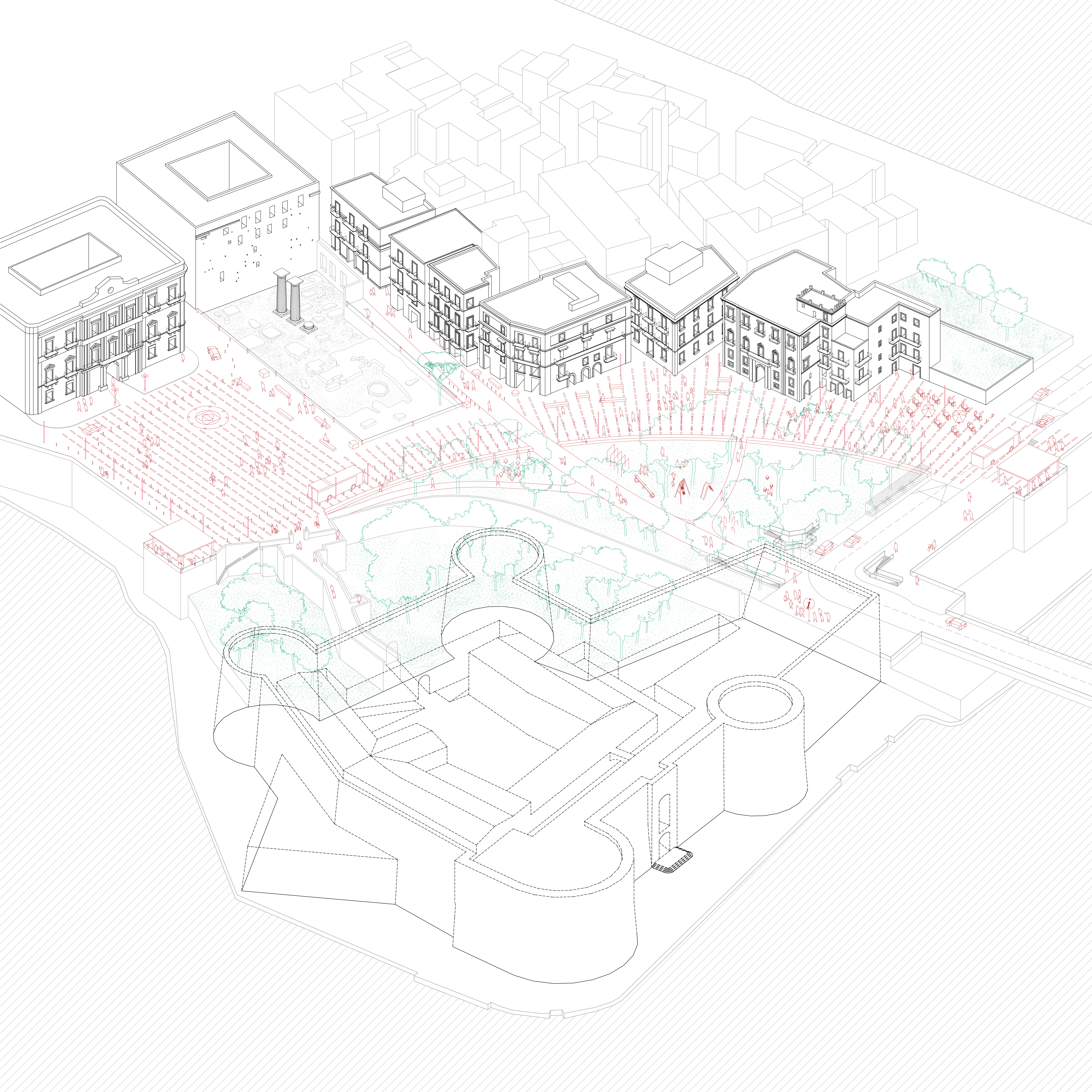
The square, currently fragmented and lacking coherence with its surroundings, is being reimagined as an urban parterre capable of restoring the Castle to a renewed physical and perceptual centrality. It serves as the fulcrum of the urban composition and the matrix of the paving design, around which street furniture, regularly distributed along the radial pattern, integrates with the stabilized concrete surfaces and stone inserts, contributing to an orderly and continuous perception of the space.
The new layout encompasses both an architectural intervention, aimed at enhancing the square as a unified, accessible, and recognizable space, and an urban one, integrating the mobility strategies and provisions of Taranto’s new Sustainable Urban Mobility Plan (SUMP) to ensure consistency with the city’s development phases. Greenery plays a central role, with the expansion of the flowerbed surrounding the Castle through the addition of native and resilient trees, transforming the area into a large urban park, designed as a place for social gathering and as a means of enhancing the ancient moat of the Aragonese Castle.